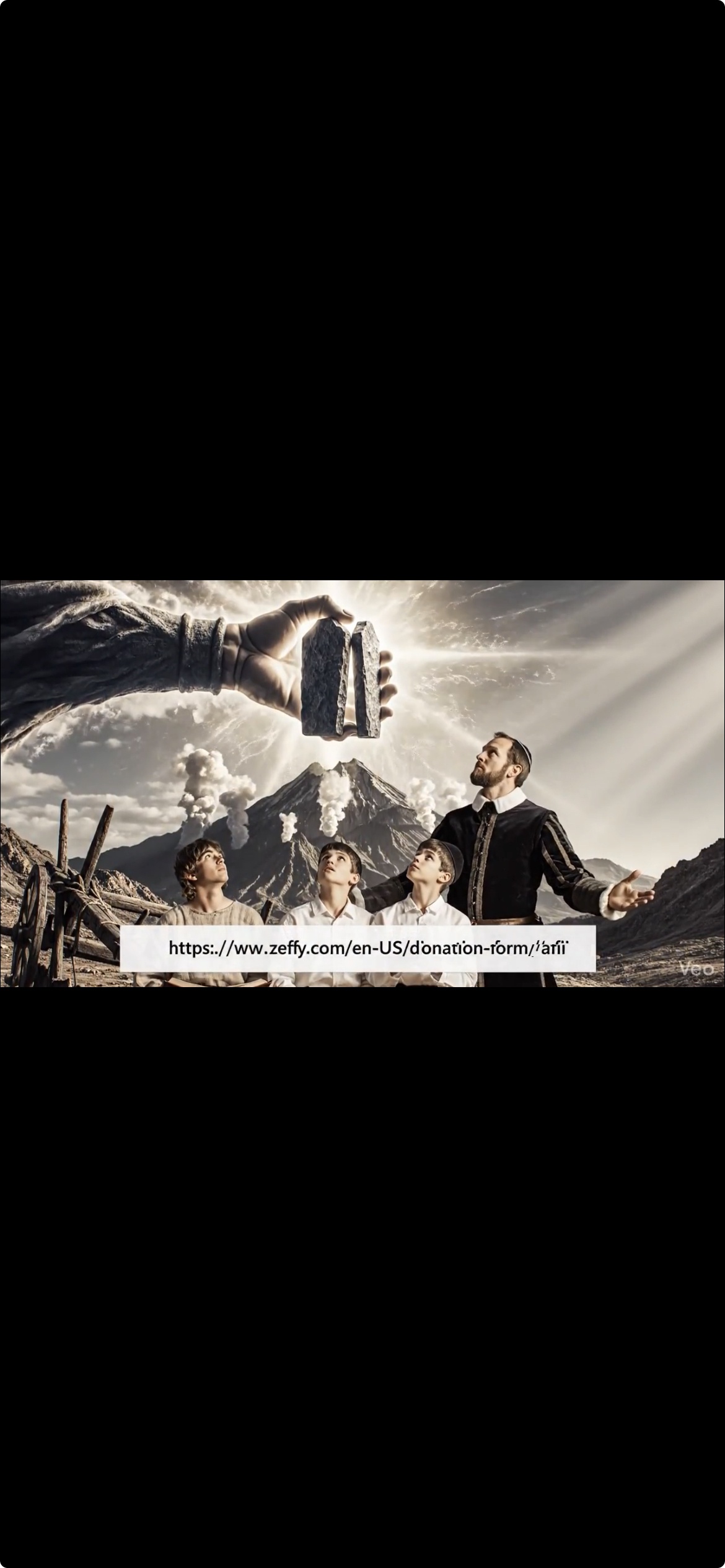
An Orthodox Yiddish Brit Chadasha — and the Triglot that accompanies it —
does not erase the distance between communities. It does not pretend that
between Jewish readers and readers who are followers of Rebbe Melech
HaMoshiach, there have not been centuries of separation. There is no attempt
to smooth over the profound theological differences that remain. But since
today is Purim, we must remember what people forget, that salvation is of, for,
and ultimately to the Jewish people, and that the remnant that has always
existed will expand until all Israel has a Purim deliverance (Romans 11:1-5, 25-26).
But what our Triglot Bible effort says is something simpler, and perhaps more important:
here is a Jewish text, written by Jews, about a Jew, debating Jewish questions —
and here it is in your language, in the mama loshn, in the script your eyes
know and your lips have always known how to sound. One more thing: properly understood,
this book does not destroy your peoplehood or diminish your Judaism. In fact, Judaism
promised at least two all-important things: the Techiyas HaMesim, the Resurrection of
the Dead, and the Moshiach Ben Dovid. The Moshiach Ben Dovid did come, did resurrect
from the dead. Therefore Judaism is vindicated. Judaism is true.
Closing Image
The Invitation
A text returning home. A conversation long deferred. A language that is both
bridge and boundary — and, now, a bridge that does not erase the boundary
but crosses it with respect.
The Work Continues
The work of Bergmann and Krelenbaum is not finished. It is alive — at
YiddishBible.net, in the Triglot, in the OJB, in the hands of readers
in Brooklyn and Jerusalem and London and Melbourne who are encountering
Scripture in their heart language, perhaps for the first time, on a screen
that fits in their pocket.
In summary, when the most influential missiologist of the 20th century (Donald McGavran, Wikipedia) edited
Dr Phil Goble's book EVERYTHING YOU NEED TO GROW A MESSIANIC SYNAGOGUE, that famous editor McGavran
opened a floodgate of blessing that is cryptically
alluded to in Galatians 3:19-20. This exhibit shows that Yiddish—chosen because of Romans 1:16’s “to the Jew
first”—functions as a laboratory language, with state-of-the-art technology producing typesetting in minutes, not months, and with complete Bible voice model audio in hours, not years. It proves that: a heritage language with fragmented textual history
can be reconstructed, its Scripture tradition can be digitized and typeset, even phonetically unpacked and
globally distributed. And all this with AI, metadata standards, and open-access pipelines that make for universal
accessibility. The result becomes a template for ANY language lacking Scripture, especially the thousands with
limited resources, few speakers, or no publishing infrastructure. Indeed, our Yiddish museum exhibits a scalable,
repeatable pipeline. Across the nine rooms, the museum demonstrates a full-stack workflow: recovery of legacy texts,
digitization and OCR/AI enhancement, metadata-rich archiving, museum-grade curation, typesetting and publication,
with a global digital delivery. This is not theory—it is a working system. Funders see not a proposal, but a
proven pipeline ready to be replicated across many of the 7000 languages of the world in Bible poverty (no or inadequate
Bible translation). Our Yiddish exhibit is in direct alignment with the 2033 Global Scripture Goals. That is, the
exhibit makes visible how this model directly supports the already-publicized 2033 targets: namely, 95% of the world receiving
a full Bible and 99.96% receiving a New Testament in just a few years from now. The museum shows how those numbers become achievable: through
automation, replicable workflows, and cross-cultural scalability. This is a great missiological inflection point
achieved by more than a dozen of the finest software engineers that we have, brilliant linguists working with
Wycliffe Bible Translators and SIL Global and others. Donald McGavran’s involvement—editing Everything You Need to Grow a
Messianic Synagogue—is reframed not as a historical footnote but as the opening of a strategic channel. McGavran's
editorial decision validated: Jewish-rooted Scripture movements, cross-cultural missiology, scalable, reproducible
systems, etc. This is the “floodgate” alluded to in Galatians 3:19–20: a divine pattern where a Jewish-first
breakthrough becomes a blessing for the nations.
Again, and this needs repeating, since Hashem's Word is to "the Jew first"
but "also the non-Jew," that single fact makes everything in this virtual museum
exhibit a prototype and a template, as well as a global delivery system, for the
7000 languages of the world. You, the virtual museum visitor, have been shown
in these nine virtual exhibition rooms how to eminently eradicate Bible poverty,
ensuring all people have access to Scripture, with already publicized goals including
95% of the global population having a full Bible and 99.96% having a Brit Chadasha
by 2033.
Wait a minute, an experienced field translator in Papua New Guinea might say. The Yiddish Triglot is not
a frontier tool for elicitation from a speaker of Tauade language in Papua New Guinea the Tauade word for
"lamb." The old-school translator’s irreplaceable contribution remains: elicitation. You still have to sit
with that native speaker and find out what his word for "lamb" is, whether it distinguishes a yearling
from a nursing lamb, and how his language handles the passive voice when the text says he was led like a
sheep to the slaughter. No template resolves that part of the process. But once you have those words —
once the elicitation work is done — the Triglot gives you the frame into which they go. And crucially,
it gives you the English translation gloss layer as a shared checking text that both the field translator
and the native speaker can point to together and say: is this what your word for "lamb" means here? In
Tanzania the Swahili term is "mwana kondoo" (literally, child of a sheep). This is where Paratext software
is needed. But in Tanzania one of your Triglots could be Swahili (anchor / first line literary standard),
Sukuma (vernacular/second line), and English (third line). And it is worth noting that John Macaulay, the
translation consultant for the Yiddish Triglot of Bergmann/Krelenbaum's Yiddish Bible, worked with African
translators to produce 70 African Bible translations and some of these insights are his.
What is being described here is not a novelty. It is a methodology.
And for the 1,600 or so languages like Papua New Guinea's Tauade still having little or no Scripture portion
at all, a replicable, community-checkable, three-layer methodology is exactly what the bottleneck demands.
Think what you could do with Farsi and its Arabic script with transliteration and English translation! Look
again at the Yiddish Triglot. What do you have?
1. A wordlist (elicited vocabulary — your word for "lamb")
2. An orthography (how to write those words down consistently with transliteration for pronounciation)
3. A grammar sketch (how words combine in this language)
4. A draft text (a trial rendering of the source)
Now look at what the Yiddish Triglot’s three-layer structure encodes in visual form:
• The word-for-word English gloss (Line 3) is a working lexicon — every word is paired with its English
equivalent in context
• The transliteration (Line 2) is a portable orthographic guide — a non-native can hear a word which the
voice model has articulated in the audio "read along" on the mobile phone YouVersion app, and hearing it, a
non-native can immediately find its written transliteration and script form
• The preserved word order in the translation English gloss is a grammar sketch — you can see where
Yiddish front-loads verbs, inverts objects, or does what English doesn’t do.
The three-layer format doesn’t replace elicitation work — but it creates the receiving structure into
which elicited words can be inserted, and all this using Paratext and its add-on software PTXPrint.
Why is the English gloss layer important? The conservative word choices are the words that must be translated.
If Moses uses "almah" and "betulah" synonymously of the same young woman in Genesis chapter 24, that fact should
color the gloss of Isaiah 7:14 almah in the singular and Song of Songs 6:8 almah in the plural. We don't
translate erroreous word choices into other languages. And this is the key insight for 7,000 languages:
if a native speaker helped by a linguist can produce even a rough word-for-word rendering of the English gloss
layer into his own language, you have the skeleton of a native speaker's interlinear for that language,
for the 1600 languages without Scripture, still in abject Bible poverty.
An Interlinear is an invitation into the culture of that Interlinear language. A Jewish person who might not
be able to read a Yiddish New Testament without the Interlinear might very well want to read it with the
Interlinear because it enables him or her to enter the culture they revere. They get to John 2:1 about the
wedding in Cana and they say, "Oh that's the Yiddish word for "marriage" that the rabbi used at my neice's wedding!"
Now they are intrigued and they keep reading. The Triglot is a two way street. Outsiders can enter a foreign
culture and its most important words, and insiders can navigate more easily their insider culture. A Jewish
person who would on principle never read an English New Testament and, furthermore, might not have the language
fluency to read a Yiddish New Testament, might on the other hand be intrigued enough with their Yiddishkeit
culture to enter the world of the Yiddish Triglot.
This exhibition is an invitation to be part of the Every Tribe Every Nation anti-
Bible poverty work, to support it, to share it, and to understand what it means
that a complete Scripture exists in one of the world's great Jewish languages,
ready to be read by anyone who opens it. What it really means is that now we can
move on to another major hurdle in reaching every tribe, every tongue, with the
Scriptures. And that hurdle is the Islamization of the West.
The Islamization of the West is a phenomenon seen in demographic growth,
increased political and cultural visibility, and expanding mosque construction
and community infrastructure with one fourth of the planet now Muslims. This
Western development means that Muslim-friendly Bibles (see the
pwa top right little 文 A icon Bible Translation drop-down menu which changes the whole pwa website to that language showing the Muslim Arabic, Bengali, Farsi, Indonesian, Pashto,
Urdu and English languages)
and also MBB (Muslim Background Believers, Khalq Jadeed submitters to God) congregation
planting preaching with Cross-Cultural Outreach will be two
main future world imperatives.
خَلْقٌ جَدِيدٌ
خَلْقٌ (Khalq) — Creation
جَدِيدٌ (Jadeed) — New
This is the Arabic phrase meaning "New Creation," and is the term used in Arabic translations
of 2 Corinthians 5:17 — "If anyone is in Messiah, he is a new creation."
See the bridge for
preaching Sola Scriptura 1Cor 4:6 like Paul did in Acts 17:23; Titus 1:12-13 with "To an unknown God" in Sura 14:19 "if
God so will, He can remove you and put in your place a new creation."
The technology unveiled in this virtual museum, with
its "to the Jew first" (Romans 1:16) pipeline and delivery system, is meant to bless
all the peoples of the world, including one out of every four people on the planet,
who are Muslims and who also must follow the Lamb
for their redemption, the Lamb who died
but whose tomb is empty.
On May 6 2026 the Jewish pulmonary specialist was showing Dr Phil Goble his lung x-ray. The doctor was British,
raised in London and Linda asked him if he was familiar with a Jewish neighborhood in London called Golders Green.
That broke the ice and he warmed up to them. Then he began describing the devastating symptom of this disease:
Air Hunger. Dr Phil Goble was praying silently that God would help him relate to the Bible the concept of Air Hunger,
the desperate, unsatisfied sensation of needing to breathe despite the act of breathing itself. In both cases, hanging
on a tree (1 Pet 2:24) and pulmonary fibrosis, the mechanics of breathing are compromised at a fundamental level,
and the tragedy is that the effort to breathe doesn’t deliver the relief it promises. In pulmonary fibrosis, the
scarring (fibrosis) stiffens the lung tissue so that it cannot expand properly. The lungs lose their elasticity —
they become, in effect, rigid — so that even a full breath doesn’t achieve adequate gas exchange, carbon dioxide
for oxygen. The carbon dioxide builds, the oxygen drops, and the brain screams for more air even as the person is
technically breathing. The gasping at end stage is the body’s desperate attempt to force more volume into lungs that
can no longer comply. In hanging on the tree (1 Pet 2:24), the chest wall is mechanically locked by the position
of the arms, creating an analogous rigidity, not from internal fibrosis but from external biomechanical constraint.
The effect on the victim’s experience of breathlessness at Gulgotha would have been remarkably similar to pulmonary
fibrosis: the sensation that breathing is not working, that air is being taken in but relief is not coming.
There is a particular horror of unsatisfied breathing. What makes both pulmonary fibrosis and hanging on the
tree (1 Pet 2:24) so terrifying is that ordinary suffocation (like drowning or strangulation) is mercifully rapid
by comparison. What pulmonary fibrosis and hanging on the tree (1 Pet 2:24) share is the prolonged, conscious
experience of suffocating slowly with the mind remaining largely alert throughout. Rising carbon dioxide, not
exchanged with oxygen, produces anxiety, confusion, and a primal panic that cannot be reasoned away. The brain’s
respiratory drive is the most ancient and insistent of all survival instincts. To have that drive firing relentlessly,
screaming breathe, breathe, breathe, while the body cannot satisfy it, is arguably among the most distressing
experiences medicine has ever documented. Palliative care physicians who manage end-stage pulmonary fibrosis
patients consider that unsatisfied air hunger one of the most difficult symptoms to control, requiring significant
doses of opioids and anxiolytics with horrendous side effects simply to bring the patient to a bearable state.
Rebbe Melech HaMoshiach had none of that. The creed speaks about suffering before Pontius Pilot, not taking
drugs before Pontius Pilot. Also pulmonary fibrosis patients frequently describe a psychological terror that
accompanies the physical sensation, a kind of existential dread layered on top of the physical suffering.
The darkness, the cry of dereliction, the felt abandonment, these map onto what we know clinically about what
prolonged carbon dioxide build-up and air hunger do to the conscious mind. The psychological and spiritual anguish
of the Moshiach's Tree wasn’t somehow separate from the physical: they were reinforcing each other in a cascade
of suffering. The Creed says simply suffered under Pontius Pilate, but that word "suffered" contains multitudes
that most who recite it have never paused to inhabit.
While Dr Phil Goble was mulling over some of these things, all the while, the Jewish doctor was staring at the copy
of the Yiddish New Testament Triglot in Dr Phil Goble's hands. It was then that the Lord showed Dr Phil Goble how to witness
to the physician. The pulmonary specialist had mentioned earlier his father's Jewish surname, which actually was the
Hebrew form of παράδεισος (parádeisos). So Dr Goble said, You know, I was a thief in college. I stole poetry books.
So if I actually had "labored breathing" with the Savior, He might use your father's surname and say to me,
"Today you will be with Me in παράδεισος (parádeisos)." The Jewish doctor liked that and took the Yiddish Triglot.
An Interlinear is an invitation into the culture of that Interlinear language. A Jewish person who might not be
able to read a Yiddish New Testament without the Interlinear might very well want to read it with the Interlinear
because it enables him or her to enter the culture they revere. They get to John 2:1 about the wedding in Cana and
they say, "Oh that's the Yiddish word for "marriage" that the rabbi used at my neice's wedding!" Now they are
intrigued and they keep reading. The Triglot is a two way street. Outsiders can enter a foreign culture and its most
important words, and insiders can navigate more easily their insider culture. A Jewish person who would on principle
never read an English New Testament and, furthermore, might not have the language fluency to read a Yiddish New
Testament, might on the other hand be intrigued enough with their Yiddishkeit culture to enter the world of the
Yiddish Triglot.
More and more Houses of Worship and individuals are reaching out now with the bad news that they are no longer
supporting Bible translation. The reason they give is that they are morally required to help the poor and Jewish
people are not poor. But who is poorer than a person without a Bible? This is Scripture poverty. But don't Jewish
people have Bibles? Well, have you looked at their Bibles? Have you done what Dr Phil Goble did for thirty years?
Dr Phil Goble compared their Jewish Bibles word for word with the faithful translations that we know and use.
Have you gone into a Jewish bookstore? Are these faithful Bibles even accessible? Are there plenty of faithfully
translated (into English) Hebrew Bibles in Jewish Bookstores also with the New Testament not at all viewed with suspicion
(Shabbat 116a) by Jewish bookstore owners? No, sadly Jewish bookstores are places of Bible poverty (Hos 4:6).
Perhaps it's time to go back to room1.html and carefully go through this every tribe
every nation virtual Bible museum again.
DONATE