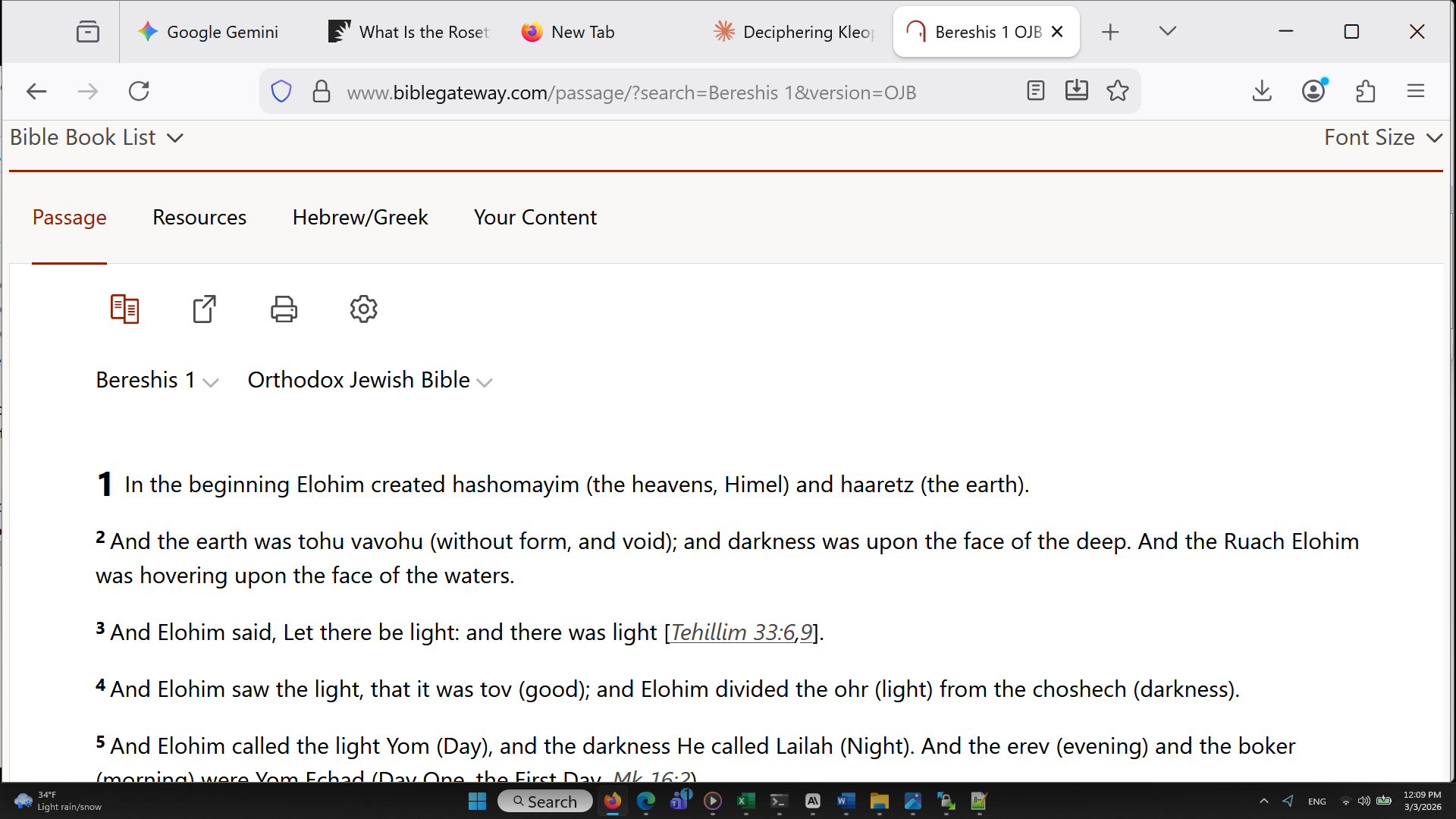
A Jewish-vernacular English translation that mirrors the texture of Yiddish and rabbinic Hebrew. Available on BibleGateway.com and at afii.org.
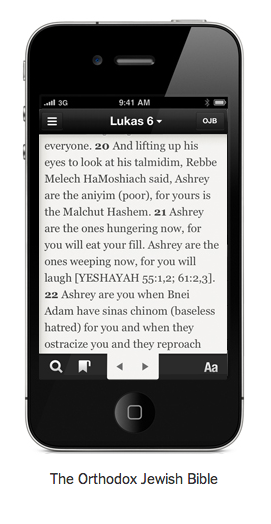
English That Sounds Like Yiddish
A Jewish-vernacular English translation that mirrors the texture of Yiddish and rabbinic Hebrew. See The Orthodox Jewish Brit Chadasha
The Triglot needs an English anchor that is not merely accurate but culturally resonant. The Orthodox Jewish Bible (OJB) provides exactly that. It revives a Jewish-vernacular English that mirrors the texture of Yiddish and rabbinic Hebrew — an English that never forgets its Jewish origins or that the Derech Hashem is at base Judaism. Judaism's non-expendable kehunah, the korban, the torn down but raised up Beis Hamikdash, the Melech HaMoshiach, the Navi, the Chacham, the zeal for the Torah (Acts 21:19-24) etc-- all are preserved in the Techiyas HaMoshiach of Rebbe Melech HaMoshiach but are not imperishably maintained in any other "Judaism." See p. 4 The Yiddish Triglot Translator to the Reader
.Where a standard English translation might read "Lord," the OJB retains Hashem. Where others write "Messiah," the OJB writes Moshiach. Where others say "synagogue," the OJB says shul. The effect is to keep the reader inside the Jewish world of the text, rather than pulling them across a cultural divide into a generically non-Jewish rendering. The reader experiences the Word where, in the Orthodox Jewish Brit Chadasha, Galatians 5:3 reads like this: "And I testify again to every one of you undergoing bris milah that such is chal (placed under obligation) to do the taryag mitzvot." What makes the OJB so unusual—and, in certain passages, genuinely illuminating—is illustrated in this passage. Galatians 5:2–3 is one of those places where the OJB’s Jewish linguistic frame sharpens Paul’s argument in a way standard English translations often flatten. Below is a structured analysis that highlights what the OJB is doing, why it differs from mainstream translations, and where it arguably IMPROVES clarity—especially for readers who want to understand Paul as a Jew speaking to Gentiles about Jewish law. ✡️ 1. What the OJB Does in Galatians 5:2–3 OJB Text (key elements) • “if you Goyim undergo the bris milah, Moshiach will profit you nothing.” • “every one of you undergoing bris milah is chal (placed under obligation) to do the taryag mitzvot.” The OJB deliberately replaces: • “circumcision” → bris milah • “obligated to keep the whole law” → chal… to do the taryag mitzvot • “law” → Gezetz (i.e., Torah law) • “justified by the law” → YITZDAK IM HASHEM… by ma'asim of Gezetz. This is not cosmetic. It reframes Paul’s argument inside the lived Jewish categories Paul himself used. 📘 2. How This Differs From Standard English Translations Most English translations render Gal 5:2–3 like this (paraphrased): • “If you receive circumcision, Christ will be of no benefit to you.” • “Every man who receives circumcision is obligated to keep the whole law.” These translations are accurate but generic. They use: • “circumcision” (clinical, Greco Roman term) • “the whole law” (abstract, Christianized phrasing) • “obligated” (legalistic but not culturally specific) They do not convey: • the covenantal weight of bris milah • the halakhic reality of taryag mitzvot • the Jewish legal category of chiyuv (obligation) • the Jewish theological category of yitzdak im Hashem (being declared righteous before God) In other words, standard translations present Paul’s argument in Christian theological vocabulary, not Jewish covenantal vocabulary. 🔍 3. What the OJB Clarifies or Improves A. It restores the Jewish covenantal context. “Circumcision” sounds like a medical procedure. Bris milah signals: • covenant identity • entry into the obligations of Torah • a binding halakhic status This makes Paul’s warning sharper: He is not talking about a surgery; he is talking about entering the Sinai covenant as a Gentile. B. It makes Paul’s logic explicit. Paul’s argument is: 1. If you take on bris milah, 2. you are taking on the entire covenantal obligation of Torah, 3. and therefore you are shifting your basis of righteousness away from Messiah. Standard translations say “obligated to keep the whole law,” which is correct but vague. The OJB’s phrase “chal… to do the taryag mitzvot” makes the halakhic logic unmistakable: • taryag mitzvot = the traditional 613 commandments • chal = a binding legal obligation. This is exactly how a first century Jew would have understood the issue. C. It highlights the Jewish nature of Paul’s warning. Paul is not anti Torah. He is anti Gentiles taking on Jewish covenantal obligations as a means of justification. The OJB’s vocabulary makes this distinction clearer than most English Bibles. D. It exposes the rhetorical force: “Moshiach will profit you nothing” is strong. But when paired with: • Goyim • bris milah • taryag mitzvot • chumra • ma’asim of Gezetz …the reader feels the intra Jewish tension Paul is addressing. Standard translations often make Paul sound like he is rejecting Judaism. The OJB makes it clear he is rejecting Gentile adoption of Jewish covenantal markers as salvific requirements. 🧠 4. Where the OJB May Be an Improvement: ✔ It restores the Jewish categories Paul assumed. Paul’s argument only makes full sense inside Jewish covenantal logic. The OJB brings that logic to the surface. ✔ It clarifies the halakhic consequences of circumcision for Gentiles, who need this clarified because of their pagan ignorance. “Obligated to keep the whole law” becomes a precise halakhic statement: taking on bris milah = taking on the full yoke of Torah, something only the Moshiach Ben Dovid, the Zun fun Der Oybershter could perfectly take on. ✔ It prevents anachronistic Christian readings. Standard translations can make Paul sound like he is rejecting Torah itself. The OJB shows he is rejecting Torah as justification for Gentiles, which is a different issue. ✔ It captures Paul’s Jewish rhetorical voice. The OJB’s diction—words like Goyim, bris milah, taryag mitzvot—makes Paul sound like the Pharisaic Jew he was. 🎯 5. Conclusion: The OJB is not a neutral translation; it is a culturally Jewish, Messianic interpretive translation. But in Galatians 5:2–3, that interpretive lens actually illuminates Paul’s argument by restoring the Jewish categories that underlie it. For readers who want to understand Paul as a Jew speaking to Gentiles about Jewish covenantal obligations, the OJB’s rendering is arguably more contextually accurate than standard English translations. And it is precisely the "read along" version needed for the left hand column of the Triglot of the updated classic Mordechai Bergmann Yiddish Tanakh and the classic Aaron Krelenbaum Yiddish Brit Chadasha.
"Its use of transliterated Hebrew terms, covenantal categories, and midrashic resonance makes it the ideal reference column for the Triglot."
The Orthodox Jewish Bible in the Triglot Architecture
As the fifth layer of the Triglot, the OJB serves as a bridge between the Yiddish-language columns and the English-speaking reader. But it is more than a bridge — it is itself a demonstration that the New Testament can be read, in English, as a thoroughly Jewish document.
Transliterated Hebrew terms carry covenantal weight. Midrashic resonances are honored rather than smoothed away. The literary texture of rabbinic Hebrew and Yiddish — the cadence, the idiom, the particular flavor of Jewish biblical discourse — is preserved and reflected throughout.
Thirty years in preparation
Every page of the Yiddish Triglot is anchored to the Orthodox Jewish Bible.
The Orthodox Jewish Bible is freely accessible online. Read on BibleGateway → | Visit afii.org →
OJB Revelation 19:7 as an Example of the Jewish Interpretative Paraphrase Aspect
The Wedding of the Seh: Revelation 19:7 through the lens of a Jewish wedding
חֲתֻנַּת הַשֶּׂה
the wedding of the Lamb
“Let us have simcha and exult in kavod to him because of the Bedeken of the Kallah of the SEH, and the Choson’s Tish and she has made herself ready.”
Read the verse word by word in the AFII Revelation 19 interlinear
An Interpretative Jewish Paraphrase
English readers already know paraphrase translations. Each one makes a deliberate choice about what the reader needs in order to hear the text.
Expands the biblical text into contemporary English.
Expands words and phrases to expose shades of meaning a literal rendering may hide.
Recasts the text in contemporary idiom for readers outside the world of the original.
Puts Jewish vocabulary, idiom, and cultural imagery back into the English text.
Rather than explaining the Jewishness of Scripture away, the OJB restores it. Revelation 19:7 is one of its most striking examples. This is not a word-for-word translation of the Greek. It is an interpretative Jewish paraphrase, meant to let the reader see Revelation 19 not as an abstract “marriage” but as a Jewish wedding: the wedding of the Seh and His Kallah.
The Seh Is the Chosson
The central identification is the most important one: the Lamb is the Bridegroom.
A lamb, a sheep
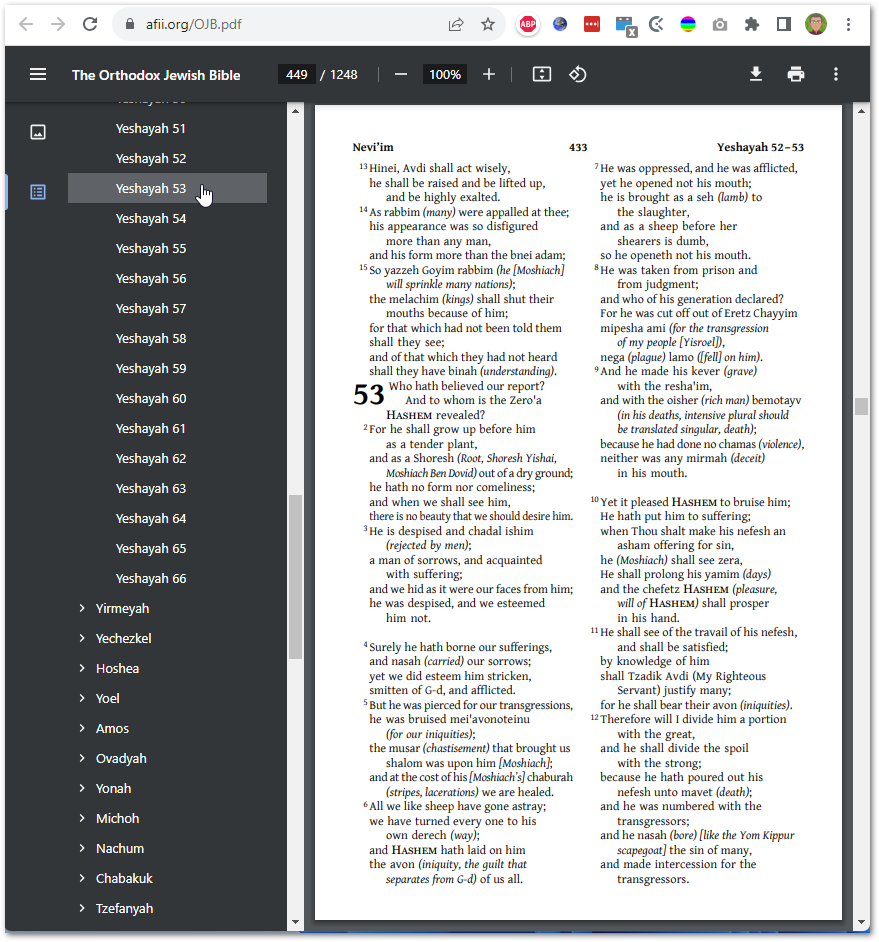
The OJB’s SEH carries the reader back into the vocabulary of the Hebrew Scriptures. The word at once evokes the Passover:
“Take for yourselves a seh…”Shemot (Exodus) 12:3
The trail continues to the suffering Servant:
“Like a seh to the slaughter He was led.”Yeshayahu (Isaiah) 53:7
The Seh therefore carries the whole arc of Passover, sacrifice, deliverance, suffering, and redemption. When Revelation presents the Lamb as Bridegroom, the Jewish reader is standing inside a story that began centuries earlier. The Passover Seh has become the Bridegroom. The sacrificial Seh has become the Chosson. The One who brought redemption now comes for His Kallah.
The Vocabulary of the Wedding
Each OJB term in the verse comes from the ordinary speech of a traditional Jewish wedding.
Kallah
Bride
Ordinary Jewish wedding vocabulary that a traditional Jewish reader needs no explanation for. Revelation’s Bride of the Lamb is heard in a Jewish register as the Kallah of the Seh. The theology is unchanged, but the atmosphere is transformed: the reader is no longer contemplating an abstract heavenly “marriage” but standing at a Jewish wedding.
Chosson / Choson
Bridegroom
The OJB’s Choson reflects the traditional Ashkenazi and Yiddish pronunciation of the Hebrew word. It is not an exclusively Chasidic term; it is familiar throughout the traditional Orthodox world. Kallah and Chosson together make the relationship between the Lamb and His Bride sound like an actual Jewish wedding.
Bedeken
The veiling of the bride
Here the OJB becomes most interpretative. The Bedeken is the traditional moment just before the ceremony when the Chosson comes to his Kallah and lowers the veil over her face. It is a threshold: the bride has prepared herself, the bridegroom has come, and the ceremony is about to begin.
The Greek γάμος (gamos) means marriage or wedding. It does not lexically mean Bedeken. The OJB is asking a different question: what does the arrival of a Jewish wedding look like? One recognizable answer is the Chosson coming to the Kallah for the Bedeken. So “the marriage of the Lamb has come” is rendered “the Bedeken of the Kallah of the Seh.” The translation has become an exposition.
The Chosson’s Tish
The groom’s table
Tish is Yiddish for table, but in Orthodox life it means far more than furniture. The Chosson’s Tish is the gathering around the groom before the wedding. He sits among the men; there is singing, blessings and l’chaims, perhaps words of Torah, and rising anticipation as the wedding approaches.
A traditional Orthodox reader, especially one at home in the Chasidic world of Boro Park, recognizes it immediately. The OJB takes the reader inside the wedding rather than merely reporting that one exists.
Simcha
Joy, rejoicing, celebration
In Orthodox speech a simcha is also a joyous occasion, above all a wedding. “Let us have simcha” does more than translate “let us rejoice”; it sounds like the announcement of a great Jewish celebration. That is exactly what Revelation 19 portrays. Heaven is not quietly contemplating a theological proposition. It is celebrating.
Kavod
Glory, honor, dignity, splendor
The Greek calls for δόξα (doxa), glory, to be given to Him. The OJB keeps the Hebrew religious word. Kavod is not uniquely Chasidic; it is ordinary Jewish religious vocabulary, and it leaves the sentence sounding naturally at home in a Jewish world.
The Kallah Has Made Herself Ready
The Greek says the bride has prepared herself, and the OJB preserves it exactly: “and she has made herself ready.”
The Bride is not waiting passively. She has made herself ready. The wedding has reached its appointed moment, the Bridegroom has come, the Kallah is prepared, and the Bedeken is at hand.
The Movement of Revelation 19
Read through the vocabulary of a Jewish wedding, the chapter unfolds as a dramatic sequence.
- The AnnouncementThe Almighty reigns.
- The SimchaLet heaven rejoice.
- The ChossonThe Seh, the Lamb, comes as Bridegroom.
- The KallahHis Bride has made herself ready.
- The Chosson’s TishThe Bridegroom is gathered with His company.
- The BedekenThe Bridegroom comes to the Kallah.
- The WeddingThe marriage of the Seh has arrived.
- The Wedding FeastBlessed are those invited to the marriage supper of the Lamb.
Then heaven itself opens, and the wedding imagery gives way to the appearing of the victorious King.
A Jewish Paraphrase Is Not a Literal Translation
The distinction must be kept. The Greek does not contain the words Bedeken or Chosson’s Tish. It says that the marriage of the Lamb has come.
| Greek | Literal sense | OJB rendering | Kind of choice |
|---|---|---|---|
| χαίρωμεν | let us rejoice | let us have simcha | Jewish equivalent |
| τὴν δόξαν | the glory | kavod | Hebrew equivalent |
| τοῦ ἀρνίου | of the Lamb | of the SEH | Hebrew equivalent |
| ἡ γυνὴ αὐτοῦ | his wife, his bride | the Kallah | Hebrew equivalent |
| ἦλθεν ὁ γάμος | the wedding has come | the Bedeken … the Choson’s Tish | Cultural expansion |
| ἡτοίμασεν ἑαυτήν | she has made herself ready | she has made herself ready | Literal |
The OJB takes Revelation’s statement and expresses it through the cultural world of a traditional Jewish wedding. That is the nature of paraphrase: it makes explicit what a literal translation leaves implicit. The Living Bible does this for the contemporary English reader, the Amplified Bible by expanding shades of meaning, and The Message by recasting the text in modern idiom. The OJB does something different. It contextualizes the text Jewishly, asking the reader to hear the New Testament through the vocabulary and conceptual world of Jewish Scripture and Jewish life.
From Exodus to Revelation
The word Seh makes the entire biblical story visible.
The Passover Seh
The suffering Servant led like a seh to the slaughter
The Lamb who has redeemed His people
The Chosson comes for His Kallah
The marriage supper of the Lamb
The Passover Seh has become the Bridegroom. The sacrificial Seh has become the Chosson. The redemption accomplished by the Seh culminates in the wedding of the Seh and His Kallah.
Would an Orthodox Jewish Reader Understand This?
A traditionally observant Ashkenazi Jew would recognize virtually every word at once: simcha, kavod, kallah, chosson, bedeken, tish, and seh.
These terms are not all specifically Chasidic. The OJB draws on a broad Jewish linguistic and cultural continuum: Biblical Hebrew, Jewish religious vocabulary, Ashkenazi pronunciation, Yiddish, and traditional wedding practice. A Chasid from Boro Park would not experience them as exotic foreign terminology. They belong to his world.
What the OJB Is Attempting to Do
The OJB is not claiming that gamos means Bedeken. It is saying, in effect: hear this wedding as a Jewish wedding.
The result does not replace a literal translation. It is an interpretative Jewish paraphrase designed to make the Jewish conceptual world of the passage visible.
The Great Revelation
The Seh who was the Passover sacrifice and the suffering Lamb is now the Chosson who has come for His Kallah.
The wedding has arrived.
The Kallah has made herself ready.
The Chosson has come.
The Bedeken is at hand.
And heaven erupts in simcha and kavod.
“Blessed are they which are called unto the marriage supper of the Lamb.”Revelation 19:9
The Seh has come for His Kallah.
With the OJB’s method in view, here is how it compares with specific English translations.
How OJB compares to specific Bible translations
| Translation | Strength | What OJB adds over it |
|---|---|---|
| KJV | Majestic English, deeply embedded in Western culture | KJV completely erases Jewish texture — OJB restores it entirely |
| NASB | Most literal word-for-word accuracy in English | NASB is precise but reads the text as Greek documents — OJB reads them as Jewish documents |
| ESV | Excellent literary quality and textual fidelity | Same limitation as NASB — Jewish context invisible |
| CJB | David Stern's translation — similar goal to OJB, more readable | OJB more thoroughgoing in its Hebraization; CJB more accessible |
| NJB | Beautiful literary English, good on Jewish context in Tanakh | Better for Tanakh study; OJB far superior for Brit Chadasha Jewish texture |
A Text for Many Audiences
The OJB was conceived for readers who stand between worlds: those with a foot in the Jewish community and a foot in broader English-speaking culture; scholars who want to read the New Testament in a translation that does not erase its Jewish origins; and Haredi readers who may encounter the text first in Yiddish and turn to the OJB English column as a familiar companion.
In this sense, the OJB is not merely a translation. It is itself an act of cultural bridge-building — one that makes the Triglot richer by its presence in the fifth column.