The Logic of the Rosetta Stone
When the Rosetta Stone was discovered in 1799, it unlocked an entire civilization. Its power lay not in any single language but in the alignment of three — the same decree inscribed in Egyptian hieroglyphs, Demotic script, and ancient Greek. Each language illuminated the others. For example, The famous Greek name Cleopatra (Κλεοπάτρα) served as an anchor to unlock the Egyptian hieroglyphs. One language illuminated the other two, and together they made decipherment possible. But an anchor was necessary; so explains the necessity of the Orthodox Jewish Bible, the anchor for the Yiddish Triglot. This is why the Orthodox Jewish Bible took thirty years to translate.
The Yiddish Triglot Interlinear is built on the same logic. It represents a breakthrough in linguistic access for communities whose language constitutes a barrier as well as a home.
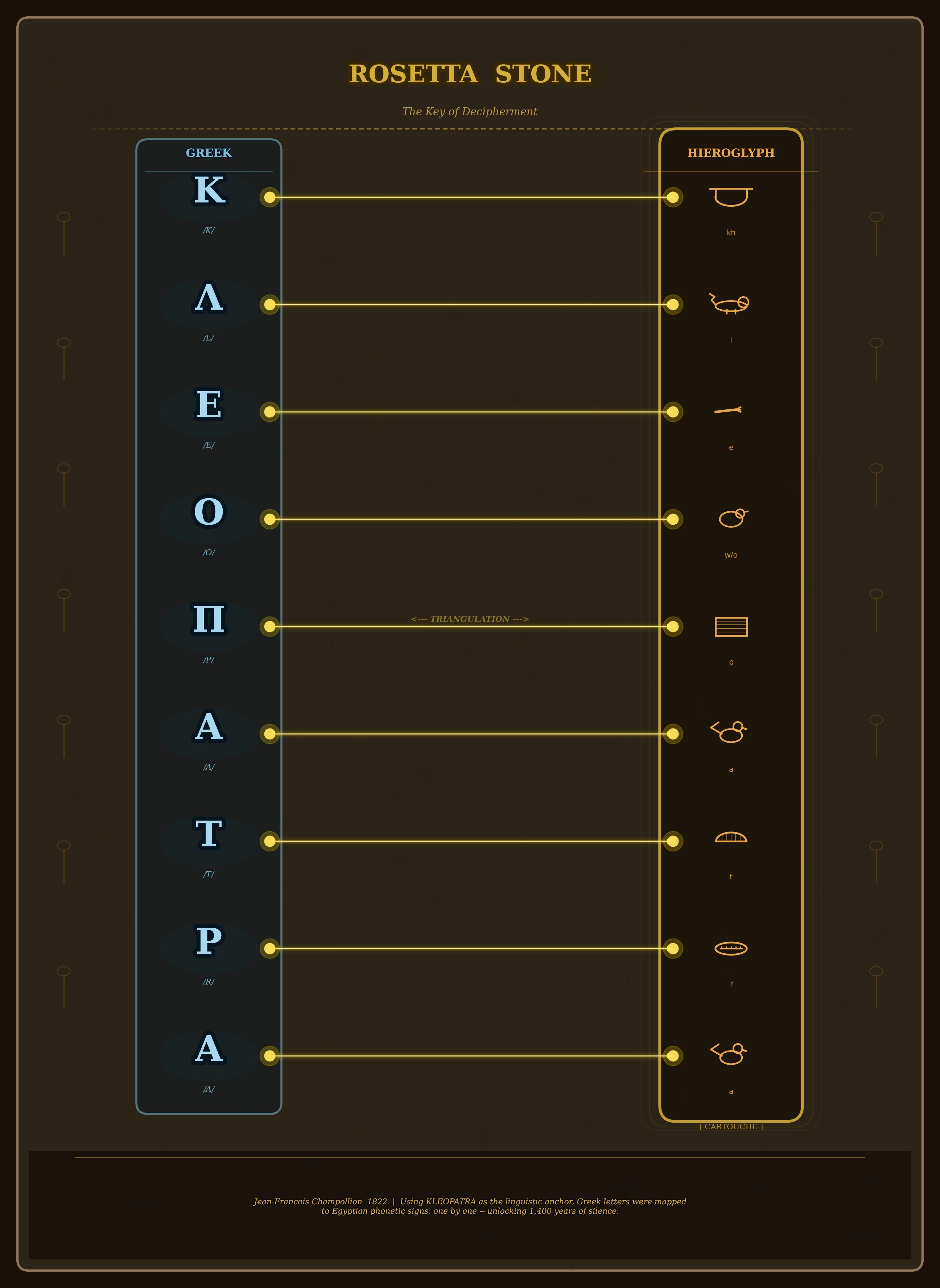
Both tools share the same principle: align multiple languages to make a locked text readable across boundaries of script and culture.
Five Layers of Alignment
The Triglot does not simply present three languages. It presents five aligned layers, each one serving a different reader's need:
!<--Replace the sample text below with actual Triglot content from your files.-->
※ Replace with authoritative Triglot text from files.-->
A Decipherment Tool
This five-layer alignment transforms the Triglot from a translation into a decipherment tool. It allows readers — whether Haredi, academic, or entirely new to Yiddish — to unlock the structure, sound, and meaning of the text simultaneously. The reader who knows only English can follow the Hebrew and Yiddish through the romanized layer. The reader who knows Yiddish script can trace every word back to its original Hebrew or Greek source.
No single layer does this work alone. The power is in the alignment. Understand this structure as a template for assembling a "decoded" low resource language.
"Modeled on the logic of the Rosetta Stone — a tool for crossing the boundaries of script, language, and culture."
This five-layer alignment is Hebrew/Greek, Yiddish, Romanized Yiddish, English gloss aligned, with the OJB as the anchor.
What has just happened with Yiddish on Purim 2026 is a Gutenberg sea-change breakthrough in digital typesetting and printing — accomplished by the PTXPrint software of SIL Global. The breakthrough is that this Yiddish Triglot is a template for what can now be accomplished to unpack and define every Bible translation word of the 7,000 languages of the world. This makes the Yiddish Triglot a prototype for 7,000 similar Triglot Bibles: the Ethiopic Triglot Bible, the Hebrew Triglot Bible, the Arabic Triglot Bible, and all 7,000 Triglot Bibles of the world — now capable of being digitally deliverable and decipherable by any English speaker. This represents a great technological leap for the Great Commission's mandate to reach every tribe and tongue to the ends of the earth.
This PTXPrint technological breakthrough in 2026 is the fruition of a developmental journey that began when the foremost missiologist of the 20th century, Dr Donald McGavran, edited Phil Goble's 1974 book EVERYTHING YOU NEED TO GROW A MESSIANIC SYNAGOGUE based on the word "synagogue" in the original language of James 2:2. This developmental journey is something man cannot boast about. It took over 50 years. In somewhat the same way as the Artemis II ignition sequence went from the ignition of the four Rocket System 25 engines and the two Solid Rocket Boosters, to the shutdown of the core stage at Main Engine Cutoff, to the Interim Cryogenic Propulsion Stage’s Perigee Raise Maneuver and Apogee Raise Burn, to Orion’s own post separation burn and final perigee raising maneuver, and finally to the great Translunar Injection burn that committed the spacecraft to the MoonThree scripts, so the Lord lifted off this Great Commission launch pad with Mordechai Samuel Bergmann's Yiddish Tanakh; then came the following ignitions: Aaron Krelenbaum's Yiddish Brit Chadasha; then McGavran's seminal edited book, EVERYTHING YOU NEED TO GROW A MESSIANIC SYNAGOGUE; then the thirty year development of THE ORTHODOX JEWISH BIBLE, then the development of Paratext Bible translation software in 1985, created by linguist-translator Reinier de Blois; then in 2020 came PTXprint the first major type-setting generation of advanced, multi-script, interlinear tooling; then in 2023 came Anthropic's Claude LLM used to recognize and modernize archaic 19th century vocabulary and orthography making it possible to modernize the Bergmann-Krelenbaum Yiddish Bible into YIVO-standard orthography — a task that would have taken human editors years, not weeks; then for the first time in history a full Yiddish Bible has been read by a custom-trained, dialect-consistent, culturally-appropriate AI voice model — and it was done in hours, not years. And this "Artemis II" ignition sequence was launched on Purim 2026! Result: a Yiddish Triglot Bible which is a prototype for all now-possible 7000 Triglot Bibles of the world's 7000 languages— now capable of being digitally deliverable and decipherable by any English speaker. Yes, but someone might want to abort this "ignition burn" space launch analogy by claiming that the McGavran edited work was not seminal. On this see below:
WHY EVERYTHING YOU NEED TO GROW A MESSIANIC SYNAGOGUE IS SEMINAL
(based on the original wording of James 2:2 — “synagogue”)
| Reason | Why It Mattered |
|---|---|
| Historical timing | Filled a practical leadership vacuum |
| Integrated model | Theology + governance + liturgy + mission |
| Field-tested | Based on real congregational experience |
| Blueprint for growth | First reproducible Messianic synagogue model |
| Leadership influence | Trained a generation of Messianic leaders |
| Balanced identity | Jewish covenant fidelity + Yeshua-centered faith |
| Missional focus | Clear strategy for Jewish outreach |